Tapered roller bearings come in two parallel universes: metric and inch. If you order the wrong one for a housing that was designed for the other, it won't fit — even if the part looks identical. This matters more than many buyers realize, because the same physical bearing size can have two completely different part numbers, two different ordering databases, and two different cross-reference charts depending on which standard it follows.
This guide is written from the perspective of a bearing manufacturer that produces both series. We'll explain how each system works, provide size reference charts for common models, and show you exactly how to identify which series you need — and how to find the right cross-reference.
What Makes Tapered Roller Bearings Special
Before comparing metric and inch, it helps to understand what makes tapered roller bearings unique in the first place.
Unlike ball bearings (which handle primarily radial loads) and cylindrical roller bearings (which handle only radial loads), tapered roller bearings handle both radial and axial loads simultaneously. This is possible because the rolling elements — the tapered rollers — are arranged so that their cone axes converge at a single point on the shaft axis. This geometry forces the rollers to handle thrust naturally, without any redesign.
The consequence: tapered roller bearings are the standard choice wherever combined loads appear together — wheel hubs, differential pinions, gearbox shafts, agricultural equipment gearboxes, and truck axles. The load rating advantage over ball bearings in the same envelope is significant: a 30208 metric tapered roller bearing (40mm bore) has a dynamic load rating of 63 kN, while a 6208 deep groove ball bearing in the same bore delivers only 29 kN — less than half.
The Metric Series: ISO 355 / DIN 720
Metric tapered roller bearings follow ISO 355 (international) and DIN 720 (European) standards. All dimensions are in millimetres.
Numbering System
Metric tapered roller bearings use a numeric designation where the first two digits identify the series and the last two identify the bore diameter code (bore = code × 5mm for codes 04 and above):
- 30204 → Series 302, bore code 04 → bore = 20mm
- 32208 → Series 322, bore code 08 → bore = 40mm
- 33011 → Series 330, bore code 11 → bore = 55mm
The series number determines the OD and width relative to the bore — heavier series numbers mean larger OD and higher load capacity for the same bore diameter.
Metric Series Families
| Series | Profile | Bore Range | Typical Use |
|---|---|---|---|
| 302xx | Light | 15–150 mm | Passenger car gearboxes, pumps |
| 303xx | Medium | 17–150 mm | Truck transmissions, industrial |
| 322xx | Heavy medium | 15–150 mm | Truck axles, heavy machinery |
| 323xx | Heavy | 17–150 mm | Differentials, high-load gearboxes |
| 313xx | Wide inner | 65–160 mm | Large industrial equipment |
| 320xx | Extra light | 20–120 mm | Compact machinery, pumps |
| 330xx | Extra heavy | 50–130 mm | Mining, construction, heavy drives |
Metric Size Chart (Common Models)
| Model | d (mm) | D (mm) | T (mm) | Cr (kN) | Cor (kN) |
|---|---|---|---|---|---|
| 30205 | 25 | 52 | 16.25 | 37.7 | 43.5 |
| 30208 | 40 | 80 | 19.75 | 63.0 | 74.0 |
| 30211 | 55 | 100 | 22.75 | 96.0 | 120 |
| 32208 | 40 | 80 | 24.75 | 80.0 | 98.0 |
| 32212 | 60 | 110 | 29.75 | 128 | 163 |
| 33012 | 60 | 95 | 27 | 91.5 | 122 |
The Inch Series: ABMA Standards
Inch tapered roller bearings follow ABMA (American Bearing Manufacturers Association) standards, previously AFBMA. All dimensions are in inches, though modern catalogs also list millimetre equivalents.
The Cone + Cup System
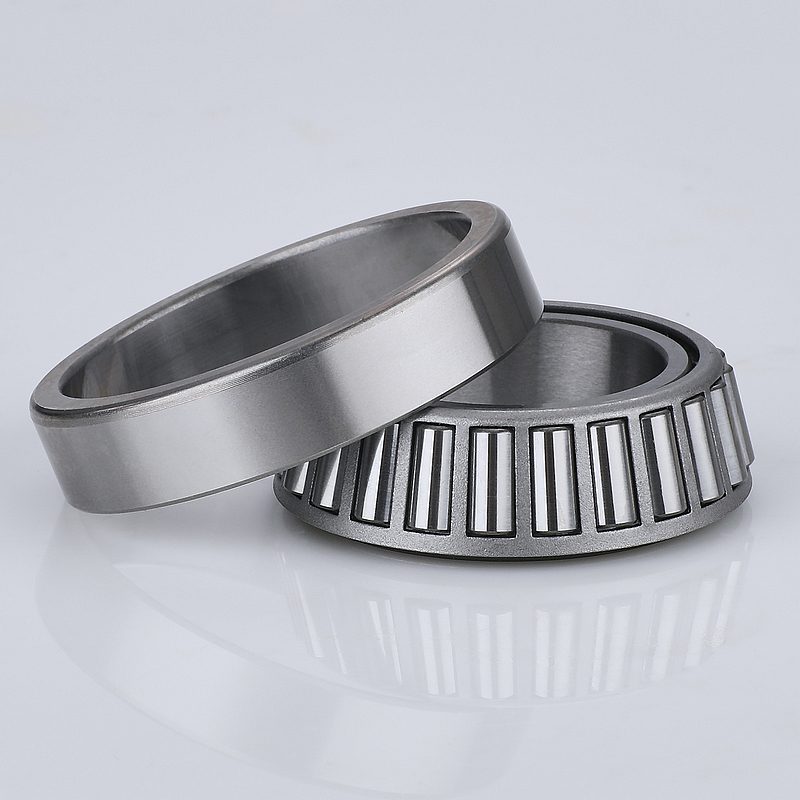
The most important structural difference from metric: inch tapered roller bearings are sold as separate components. The inner assembly (inner ring + rollers + cage) is called the cone, and the outer ring alone is called the cup. Each has its own part number.
When ordering, you need both:
- Cone: e.g. 25580 (inner ring assembly)
- Cup: e.g. 25520 (outer ring)
Together, this pair is written as 25580/25520. The convention is cone number first, then a slash, then cup number. This separation is actually useful: when a wheel hub wears out from contamination, sometimes only the cup is damaged while the cone is still good — you can replace just the worn component.
Inch Series Naming Families
Inch bearing part numbers follow families identified by prefix codes:
| Family | Bore Range | Typical Application |
|---|---|---|
| LM (Light Medium) | 0.5″ – 1.75″ | Trailer hubs, small axles, passenger car rear |
| HM (Heavy Medium) | 1.0″ – 3.5″ | Truck axles, agricultural equipment, construction |
| M (Medium) | 1.0″ – 3.0″ | Light truck, SUV rear axles |
| L (Light) | 1.0″ – 2.5″ | Trailer bearings, wheel hub kits |
| Numeric (25xx, 29xx) | 1.0″ – 2.5″ | Wheel bearing kits, common North American sizes |
Inch Series Size Chart (Common Cone/Cup Pairs)
| Cone / Cup | d (mm) | D (mm) | T (mm) | Cr (kN) | Cor (kN) |
|---|---|---|---|---|---|
| LM11949/LM11910 | 19.05 | 45.24 | 16.64 | 25.1 | 25.5 |
| LM48548/LM48510 | 34.93 | 65.09 | 18.03 | 46.2 | 52.0 |
| 25580/25520 | 44.45 | 82.93 | 23.81 | 73.5 | 87.0 |
| 29590/29520 | 50.80 | 95.25 | 23.81 | 81.5 | 104 |
| HM218248/HM218210 | 88.90 | 152.40 | 39.69 | 223 | 292 |
Metric vs Inch: Direct Comparison
| Feature | Metric (ISO 355) | Inch (ABMA) |
|---|---|---|
| Dimension unit | Millimetres | Inches (mm listed in catalogs) |
| Ring sold as | Complete bearing (one part number) | Cone + cup separately |
| Common in | Europe, Asia, global industrial | North America, agriculture, trailers |
| Standard OEM for | European/Japanese cars, gearboxes | American trucks, trailers, farm equipment |
| Numbering logic | Series + bore code (e.g. 30208) | Family prefix + sequence (e.g. LM48548) |
| Cross-reference | SKF, FAG, NTN, KOYO (ISO numbers match) | Timken, SKF, NTN — separate inch catalog |
| Can they swap? | No — always verify d, D, and T dimensions before substitution | |
How to Cross-Reference Between Systems
Metric and inch tapered roller bearings do not share a systematic conversion formula — you must look them up in a cross-reference table. Here's the practical workflow:
Step 1: Identify the dimensions of the original bearing. Measure bore (d), outer diameter (D), and assembled width (T) with a caliper if needed. Even a worn bearing retains its original dimensions.
Step 2: Identify the standard. If the bearing has a numeric code like 30208 or 32212, it's metric ISO 355. If it has a prefix like LM, HM, M, L, or a pure numeric code like 25580, it's inch ABMA.
Step 3: Search by dimensions. Most major bearing brand websites (SKF, FAG, Timken, NTN) have searchable databases by bore × OD × width. Enter your three dimensions and filter by "tapered roller" to find all equivalent part numbers across metric and inch catalogs.
Step 4: Verify contact angle and capacity. For critical applications, confirm the dynamic load rating (Cr) and static load rating (Cor) of the cross-reference match or exceed the original. A metric and an inch bearing can have identical d×D×T but different internal geometry, resulting in different load capacities.
OTT provides cross-reference assistance for both metric and inch series. If you have an original part number from any brand — Timken, SKF, FAG, NTN, NSK, KOYO, or an OEM number — our technical team can match it to the OTT equivalent.
Which Series Should You Choose?
For replacement parts, always match the original series. The housing and shaft were machined for specific dimensions, and the correct series is whatever was originally fitted.
For new designs, the choice is largely regional and application-driven:
Choose metric if your machine is designed to European or Japanese standards, if your supply chain is primarily European, or if you're building new designs where metric fasteners and dimensions are used throughout.
Choose inch if you're building agricultural equipment, trailers, or heavy trucks for North American markets, or if you need to maintain parts interchangeability with Timken or SKF inch catalogs that North American distributors stock.
For global aftermarket distributors, stocking both series makes sense — metric for European and Asian vehicle coverage, inch for North American truck, trailer, and agricultural equipment.
View the Full Catalog
OTT manufactures both metric and inch tapered roller bearings from the same IATF 16949-certified facility. Our catalog covers:
- Metric series: 110+ models across 302xx, 303xx, 322xx, 323xx, 313xx, 320xx, and 330xx families (d = 15–160mm)
- Inch series: 80+ models across LM, HM, M, L, and numeric families (d = 12.7–88.9mm)
Browse the full specification tables — including Cr, Cor, dimensions, and cross-references — on our Tapered Roller Bearings product page.
Related Guides
- Tapered Roller Bearings — Full Catalog — complete metric and inch spec tables
- Wheel Hub Bearing Kits — complete kits including inch tapered roller bearings for trailers
- Signs of a Bad Wheel Bearing — applies to tapered roller wheel bearings too
- Alternator Bearing Guide — deep groove ball bearings for comparison